A good beginner workout app should give you a clear plan for your goal and equipment, show exactly what to do in each session, make logging simple and offer a realistic fallback when you miss a workout or run short on time. Avoid choosing on exercise count alone: a smaller programme you can follow is more useful than a huge library that leaves every decision to you.
Start with the job you need the app to do
Some apps are trackers, some are video libraries and some build programmes. If you already know how to train, a tracker may be enough. If you are a beginner who keeps asking what to do next, look for a structured plan rather than an endless menu.
Be specific about your setting too. A home workout app should work with the equipment you actually own. A gym app should explain the session without assuming you already understand every machine or training term.
Look for six beginner essentials
The app should lower decision load while leaving enough control to report that something does not fit.
- A plan matched to your goal, experience, schedule and equipment.
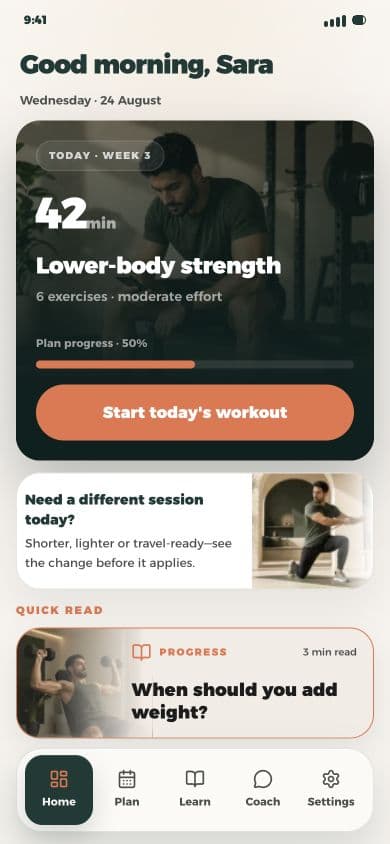
- One obvious next workout rather than multiple competing choices.
- Clear sets, repetitions, rest and exercise guidance.
- Simple logging that does not interrupt the workout.
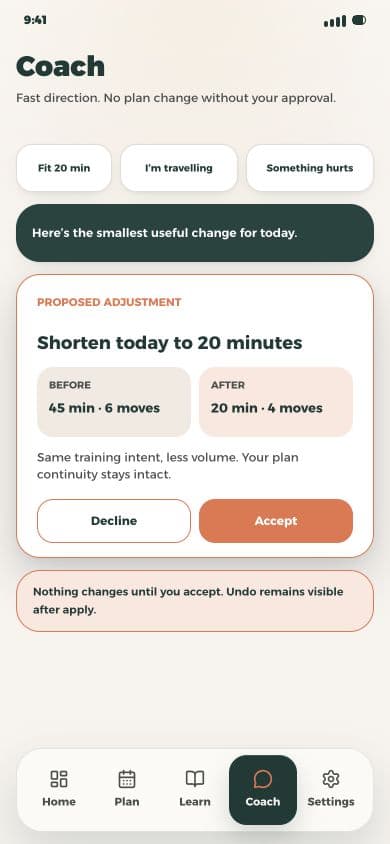
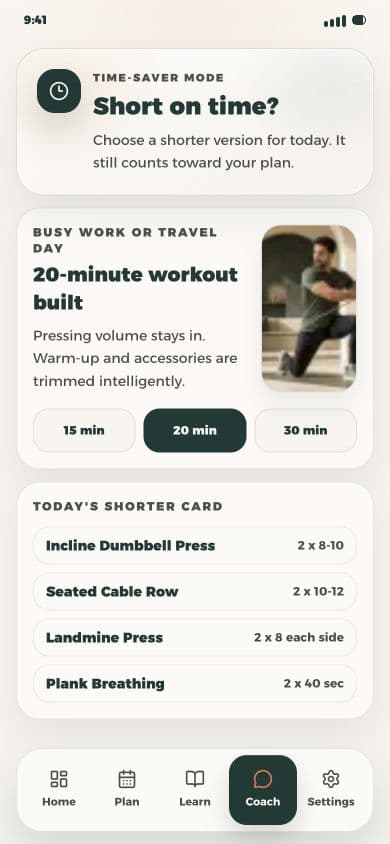
- Shorter, lighter or replacement options when needed.
- A visible way to review progress without relying only on streaks.
Check whether the plan survives a difficult week
Most plans look sensible on day one. The better test is what happens when you miss Wednesday, travel on Friday or only have twenty minutes. A beginner should not have to decide alone whether to double up, restart or abandon the week.
Useful flexibility means preserving the purpose of the programme while changing the size or timing of a session. It does not mean generating a completely unrelated workout every time life changes.
Do not confuse more features with better guidance
Nutrition tracking, social feeds, wearables and challenges may be useful, but they do not fix an unclear training plan. Start with the smallest product that solves your main problem well.
24/7 Fit is designed for beginner-to-intermediate users whose main need is clear training direction across the gym, home and travel. It is not positioned as rehabilitation, elite sport programming or live human technique coaching.
Use the first week as an evidence test
By the end of a trial, you should know what the app asked, why the plan fits those answers and how it behaves when you need a change. If those three things are still unclear, the product is adding another layer of decision-making rather than removing one.
For a beginner, clarity and a repeatable week matter more than the largest exercise library. Choose the app that makes today obvious and tomorrow adjustable.
Common questions
Should a beginner use a workout planner or a workout tracker?
Use a planner if you need help deciding what to train. Use a tracker if you already have a programme and mainly need to record it.
Do beginner workout apps work without a gym?
They can, provided the plan is built around bodyweight or equipment you actually have and includes a sensible way to progress.
Is 24/7 Fit suitable for complete beginners?
It is designed for beginner-to-intermediate users who want a structured plan and flexible guidance. Serious injury rehabilitation or specialist performance goals need qualified human support.
Sources and further reading
General training information only. Stop if you feel pain, seek medical advice for symptoms or injuries, and use a suitably qualified professional when you need assessment or hands-on coaching.